Observe
Watch the pen angle, pressure and sequence of every stroke.
Classical Arabic Calligraphy · United Kingdom
Traditional Naskh and Thuluth, taught through disciplined practice and close correction — and original works written by hand.
The practice
Naskh and Thuluth studied through the traditional meshk — model, practice and correction — in the line of the Ottoman school.
Established homeschool cohorts, workshops and school & mosque demonstrations across the UK, with live online study.
Commissioned pieces and original calligraphy, composed and signed by hand.
Focused, traditional arts build the patience, attention and foundational thinking that every child needs alongside modern digital tools.
For children and adults of all backgrounds, the slow discipline of the pen develops deep creative thinking that screens alone cannot give.
See the ways to learnWhy Classical Calligraphy?
Every letter is governed by the nuqta: a precise rhombic measure formed by the pen itself.
Progress emerges through repetition, close correction and attention—not shortcuts.
Enter a continuous manuscript tradition transmitted through study, practice and exact correction across centuries.
The classical method
The classical method brings the teacher, model and student into direct study. Each letter is examined through proportion; each line is returned with precise correction. Progress is gradual, embodied and attentive—protecting the integrity of a tradition transmitted across generations.
Watch the pen angle, pressure and sequence of every stroke.
Repeat with intention until measure becomes instinctive.
Refine the hand through exact, personal correction.
Curriculum & scripts
Each stage develops the eye and hand required for the next. Students progress by demonstrated readiness, not by the calendar.
Start with a three-month term.
Register to learnDiscover the tradition
Arabic calligraphy developed over many centuries, particularly through the writing and preservation of the Qur’an. Rather than being invented by one person, it was gradually systematised, refined and transmitted from master to student.
c. 885–940
He established the foundations of the proportional system of Arabic calligraphy, using the dot and the alif as measurements for constructing letters.
Selected works
A rotating selection of original works. Open the central piece to study its details and context.
Commission a bespoke piece inspired by these works.
Commission a work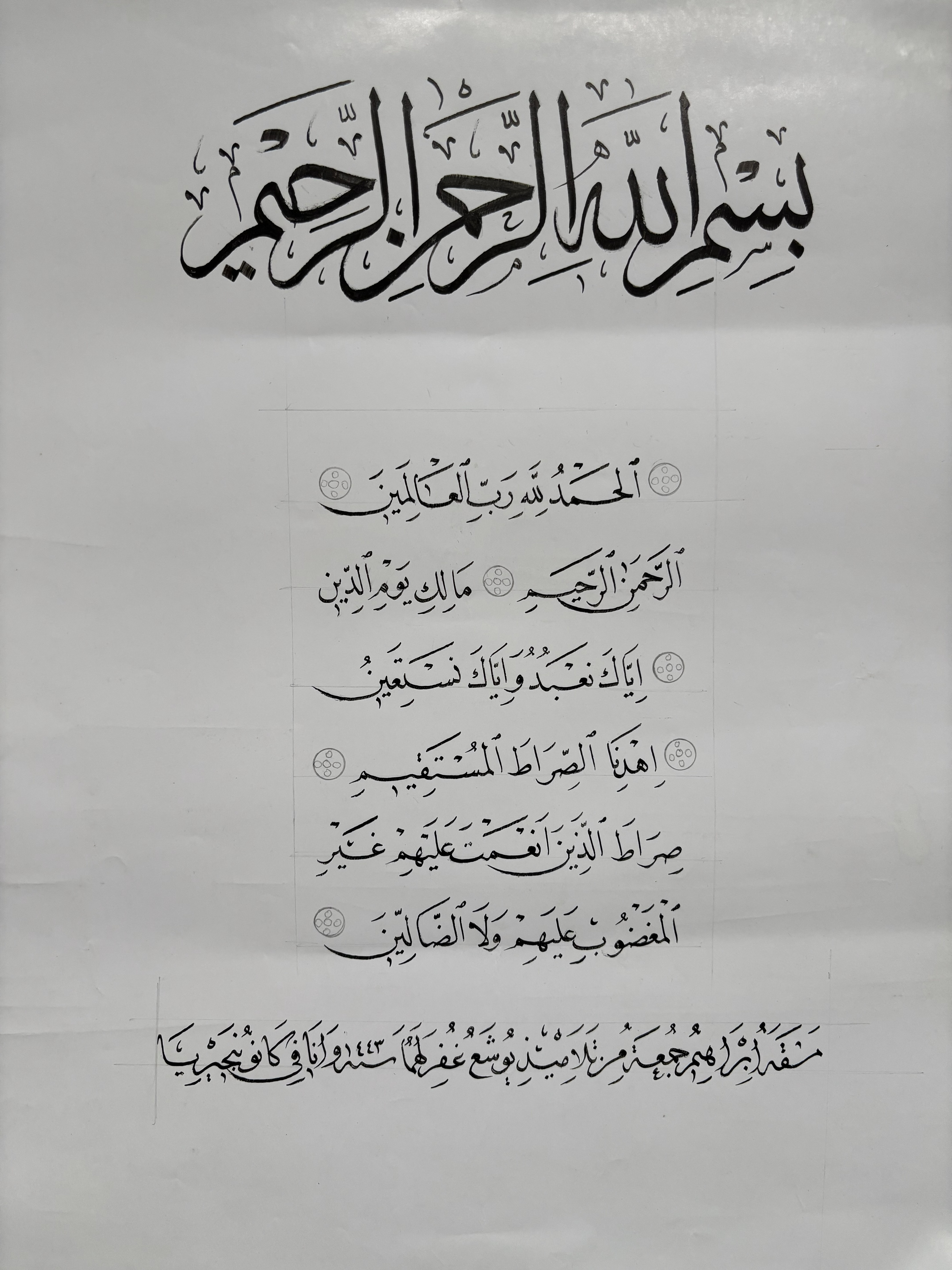
Surah Al-Fatiha · Jali Thuluth & Naskh
About the Calligrapher
Hattat
For over ten years, Hattat Ibrahim Jum’ah has devoted his practice to classical Ottoman calligraphy — studying Naskh and Thuluth through the traditional meshk under renowned teachers, and now transmitting its measure, etiquette and spirit to students across the UK and online.
“The line becomes beautiful only when the hand learns humility.”
Study with Hattat Ibrahim — ages 10 and above.
Student voices
“I feel really proud every time I finish a new lesson and see that my writing is better than when I started.”
Questions
No. Letter anatomy, proportion and movement are taught visually. Knowledge of Arabic can enrich the experience but is not required.
Admissions are now open
Tell us where you are in your practice. We will recommend the most fitting path into the tradition.